
Healing together
A whole-of-organism, process-relational approach

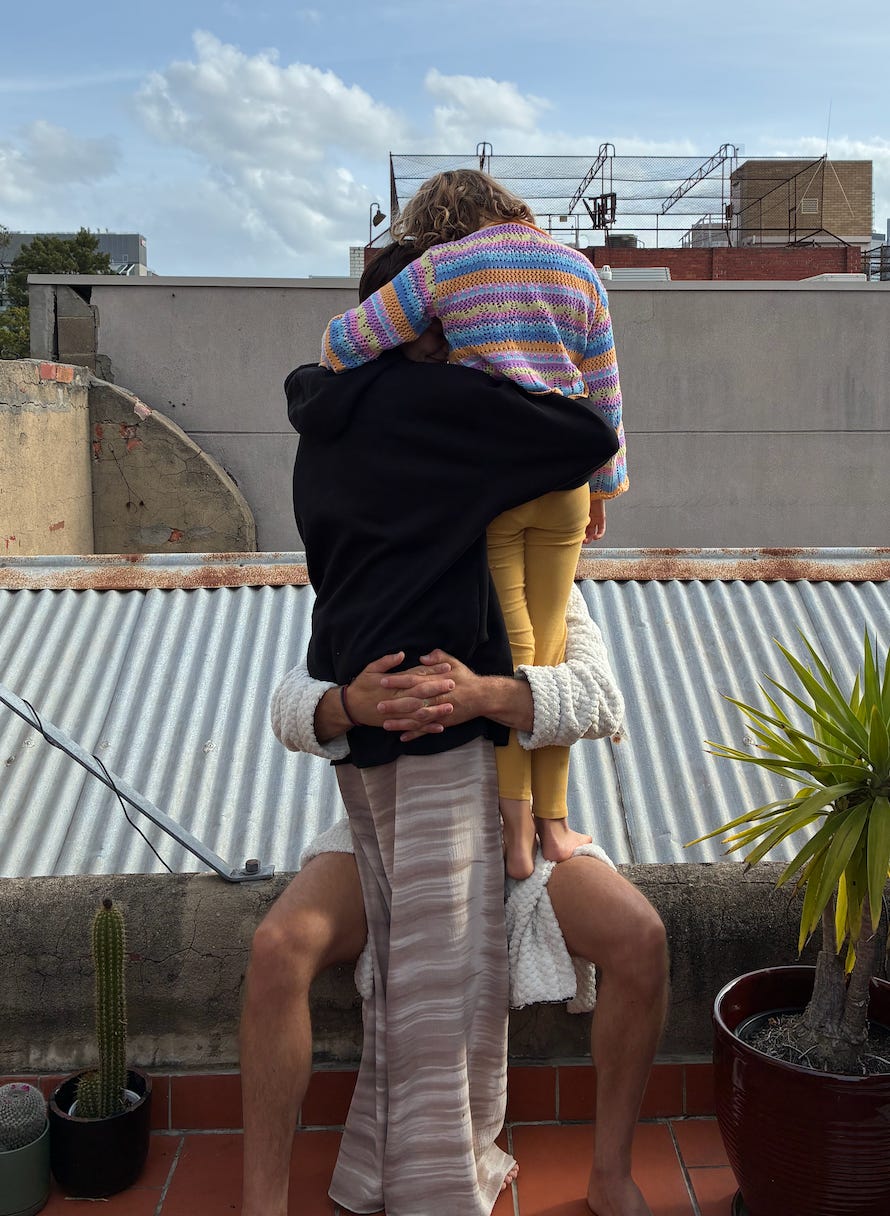
Something I am living at the moment is a shared process with my partner. A process that operates and is experienced at many levels. The first is the level of our unmaking, reorienting and becoming. The process of learning about past, situating present, cultivating new capacities and evolving patterns in service of new possibilities. The developmental process of human-ing in relation, if you will.
But this is not just lived as ‘experienced directly’. It’s not just something we practice for the benefit of ourselves and our family. It is something we are actively shaping to support others in practicing (bridging Esther’s somatic therapy work with my philosophical counselling). We will share plenty more about this over the comings months. There’s no rush. But it is coming.
What I may do between now and then is test different frames for how I describe aspects of this process. Some more technical. Some more poetic. Some that don’t quite fit either, whatever either means.
Here is something I recently wrote on my phone (actually whilst cycling on the stationary bike). I wrote it quickly. But it feels resonant. It’s an expression of an evolving understanding. Something I am, as I* clarified a moment ago, articulating in various ways.
*weirdly my autocorrect tried to change I to AI.. Next-token prediction has a self-serving Telos here people!!!
Anyways. Here it is. A very brief exposé… an exploration of the complexity of the whole human organism, its needs, the way we are impacted by the world (the way the organism learns / adapts to try protect against wounds, meet certain unmet needs etc.) and the ways in which we can, over time, and with patient, loving effort, evolve the entirety of who and how we are.
…
The human organism, like all other organisms, is always attempting—through diverse processes of embodied, embedded, enacted and extended cognition (plus plenty of other related processes)—to meet its needs (the fundamental needs of attaining calories, maintaining the correct body temperate, consuming water etc. are obviously part of this). Yet the human organism is, perhaps, in important ways, different than many other organisms. They have wildly complex minds, are deeply, deeply social, work with the weird wonders of abstraction purposefully, and, regardless of how hard they try, cannot escape their existential orientation. So, just as much as food and warmth and shelter, they need to be seen. They need to be heard. They need to be valued by important others. They need to belong in this world. They need to feel safe. They are a process of becoming, grounded in and essentially fuelled by love.
**one of the ways we think about this is through the NeuroAffective Relational Model’s (NARM) five core adaptive survival strategies, each rooted in basic developmental needs.. We also think through the lens of Character Adaptation Systems Theory (CAST)from Henriques. Basically the goal here is to see the organism as a whole; biological, psychological, social, existential etc. we have not found the one right way, instead working with different theoretical contributions as we explore how to situate our lived experience and evolving work with clients).
However, the world—which includes those nearest and dearest—often fails to meet many of these needs (rarely deliberately of course).
When a human being is young they are entirely dependent on those around them. As they develop in their early years they remain dependent, but less and differently so.
In various ways, through lack of attunement or incapacity or plenty of both, those the child most relies on ‘fail’. This is not a value judgement but a statement of fact relative to the human organisms’ needs.
They may be left alone. They may be ignored. They may be shunned or shamed. They may be overburdened.
This process of unmet needs—along with the way this and related processes or events wound us—need not be extreme. Although, of course it very unfortunately can be, taking the form of significant wounds of various kinds.
The human organism, the being in the ongoing process of becoming, responds, attempting to navigate the world and have its various needs met. Through this process, so often taking on various failures as their own.
I am not worthy. I not enough. I do not belong. Something is wrong with me. More generally, and something of a gestalt of the four point before, I am not safe.
This isn’t narrative per se. At least not in the very early years. But these are the subconscious ‘beliefs’, deeply held, entirely embodied (i.e. contributing to, and being reinforced by, neurophysiological patterns) that eventually become narrative. That eventually become the ground of identity itself. That become the lens through which this particular being interprets and thus experiences the world.
When this happens, entirely outside of self-consciousness in the early years, the organism adapts (learns and changes). This adaptation is an attempt to meet the needs of a relational being; to be cared for, to belong, to feel truly safe.
But this attempt to meet needs can often become maladaptive (meaning, the organisms’ attempt to protect itself, to find a way to belong etc. makes life significantly harder than it might have to be).
A negative sense of self.
A heightened sense of danger.
A shame based identity.
Self sabotage.
Bodily symptoms.
Etc.
All narrowing the field of possibility. All limiting, to some degree, full engagement with life’s complexity.
Let’s explore one of these dynamics.
Bodily symptoms (those of a psychophysiological, not structural nature) arise at some level when the brain anticipates danger (the ‘mechanism’ of the false danger signal is the brain interpreting something that is safe—such as sensations from the knee—as dangerous. It is, in effect, an anticipation of danger, a false interpretation). This happens because it has internalised a model of the world that is ‘fear based’ (the result of needs not being met and of wounds being inflicted, the most fundamental of which is the need to feel relational, emotional and physical safety). These anticipations of danger produce the bodily phenomena (they are not ‘just in the head’. The sensations, whether pain or headaches or fatigue, or any other form they take, are very real. They just result from psychophysiological processes / pathways*** rather than structural damage. None of this is to say this is the only way ‘bodily symptoms’ arise. Obviously. This is just a massively misunderstood and mistreated way that bodily symptoms do arise).
***this paper is a rather beautiful demonstration of this process, along with the way ‘Pain Reprocessing Therapy’ is used to help people with psychophysiological pain (back pain in this case) overcome the symptoms (and yes, this can even the case when people have structural abnormalities that are clearly observable through imaging techniques. These are often referred to as ‘normal abnormalities’). I learned about this, originally through my own experience, by working with a Mindbody Medicine Group at Harvard Medical School. Since then I’ve been fortunate to keep learning about this through the literature, engaging with clinicians, and living the process myself.
And that’s just the very brief explanation of the neurophysiological mechanism (often described through the scientific lens of predictive processing, housed within a more complex**** psychophysiological process.
****I say more complex partly because mind may well not be reducible to brain / body process. In formal parlance, brain might not be the necessary and sufficient condition for mind. But there’s a lot more to this claim of relative complexity. That’s for another time.
But there’s more to it than this (and here’s where I move away a little from what is becoming well established, empirically grounded scientific insight, towards what you can absolutely consider a more speculative view*****. This is not to say it’s woo in any way. Just that it takes a broader view of the organisms adaptive capacity). The system isn’t just making a mistake. This is more than just ‘prediction error’. This is more than just not feeling safe (having learned danger) and getting the particular type of danger ‘wrong’ (i.e. not being relationally safe, yet giving the signal of a bodily problem that doesn’t structurally exist).
*****This speculation has some grounding, however. I don’t really think it’s as much of a leap as some folks might think. If, of course, you treat the mindbody system as being an entirely dualistic system, and you treat the body like a machine, then it’ll feel like a huge leap. But, if you shift the philosophical underpinning a wee bit it’s not a stretch at all. The mindbody system is ‘one system’ in an important sense. It’s not meaningfully separable. Bodily process impacts mind. Mind / psychological process impacts body. This is complex causality, but causality nonetheless. I’ll give one example to highlight this point; psychogenic aphonia. This is the name given to the process of a person losing their voice due to emotional distress, something that clinicians describe as often occurring after the loss of a loved one. Might this be some kind of invitation to go within, to actually be with the depth of the emotion you are being called to process? Maybe. My experience leads me to believe this could in fact be the case. Oh, and Aphonia can also occur from straining your voice. That is the more common clinical presentation.
The system is trying to meet needs.
If something is wrong with my body, I might be cared for. I will be given attention and support. Attention and support I desperately need.
So this process—parts of which are observable neurophysiologically—so often described as ‘the brain learned danger and is now over-anticipating danger which results in very real bodily sensations that do not have an underlying structural cause’ is simply the pathway through which the organism, bound by certain constraints and driven by various fundamental motivations / needs, moves the entire being towards the care that is needed. The care that wasn’t previously received.
Seeing this adaptive process, not simply as a mistake (a highly mechanistic view. Not wrong, but incomplete in my opinion) but rather as an attempt to fulfil unmet needs, is game changing.
It does not mean the false danger signals aren’t happening. They are. It does not mean the person experiencing this doesn’t have to ‘unlearn’ the false sense of danger. They do. The person needs to learn to feel safe. They need to learn to regulate. They need to learn to once again go towards difficulty with courage. And through this phased exposure, they can teach their nervous system that they are in fact safe. But instead of the person, yet again, seeing themselves as ‘having something wrong with them’, it situates this complex phenomena in a more coherent and holistic frame. An evolutionary frame. A frame that speaks to the nature and function of a complex, minded, existentially oriented social organism; the human being.
This is one of the many means by which the organism seeks to meet its needs; it sends signals we cannot ignore. Signals that require us, in some way shape or form, to seek change (even if that change comes from the process of really not trying much at all. Here I allude to the ‘paradox of change’ as it sometimes known. When we pressure ourselves to get better, that reinforces the same process of danger signalling. To ‘get better’, that is, to teach the complex system that is us a deeper sense of safety, so that said danger signals can soften and then eventually be replaced by other new ‘pathways of safety’, we need to allow ourselves to be as we are. We need to accept what is happening. And we often need to healthily metabolise the wounds and unmet needs of the past, building capacity in the process that can help carry us forward with less fear etc.).
As a result, this, like to many other adaptive processes that become maladaptive in a way—they make life more, not less difficult—becomes an invitation. Something not to run away from but to move courageously towards.
When seen this way, a person can immediately become more generous towards themself. This provides a far more interesting and useful foundation from which to reorient… I no longer need the false danger signals. They served me in a way. They were an attempt to encourage me to seek care. To learn, for the first time, how to feel safe in relation. I have the patience, compassion and power to move beyond them. I have the power to healthily meet my fundamental needs in relationship. This may take time. There will be setbacks. But the complex system that is me can learn anew, can evolve based on having these fundamental needs healthily met. I no longer need to hide from the world. I can be in this world because I belong in this world.
That is (psychophysiological symptoms or ‘neuroplastic pain’ as it now commonly known), of course, just one example. One particular direction that an organism can take in an attempt to meet needs that have been systemically unmet earlier in life. There are many strategies. Many experiences. But they share a core; the learned sense that one is unworthy of love. That one is not enough just as they are. That fundamentally, the problem is with them.
If we could start seeing the experiences we have, the ways we act, and the impact this has on the world through this more ‘whole-of-organism, process-relational’ view, we could really help people in ways that they often aren’t helped. We could really help society in ways that it it so desperately needs.
That’s what Esther and I are working on, patiently, in the background (at the intersection of somatic therapy and philosophical counselling). We work with the entire being that is you, grounded in the broader context of your full existence. We attempt to thoughtfully de-pathologise what can be thoughtfully de-pathologised (for example, if you are experiencing the bodily sensations referred to as anxiety, we don’t jump to say hey! You HAVE anxiety, assigning a label to you as if a dynamic process is something you own and need to identify with. We try to understand why the self organising, self making system that is you is sending a particular form of anticipatory danger signal. We work to understand not just what you are experiencing now but why this may have arisen in the first place, noting that this is not always a verbal process. From that place of engaging with past and the way it has shaped you, we begin, through various means, to support you in teaching your nervous system that you are in fact safe. As this process unfolds, you become less conditioned. You become freer in a sense; you have more agency to act in this world. It becomes clearer not just how the world shapes you but how you can shape yourself in the continual process of your becoming. We do so not through static rules or rigid procedure but through dynamical shared process.
This shared process is grounded in an evolving theoretical understanding of the complexity of the human organism. It is tested, each and every day. It is refined constantly. This theory is met not just with the practice of being with clients but through the depth and challenges of our own lived experience. This is a process that, once started, does not simply stop. It becomes part of your ways of being. At least it has for us.
We do not have all the answers. No one does. But we are here to help. To create space. To offer new opportunities. To help you evolve in the ways that only you are capable of lf leading, acknowledging this really does have to occur in relation.
This, in our opinion, is what healing so often looks like. And it’s a process that arguably we all must go through if we are to make our individual and collective existence truly better than it is today.
With φιλία (philía),
Nate
Disclaimer: This is not intended as medical advice, nor is it intended to suggest that biomedical interventions are unhelpful or unneeded or anything of the sort. Modern medical science and medical practice works wonders in so many different contexts. This is an attempt to express something complimentary to our existing paradigm of biomedical science, an approach to ‘healing’ that works with the biospychosocial complexity of the always learning, always adapting (almost always entirely unconsciously by the way) human organism and our ‘survival physiology’ (along with the various ways this survival physiology and survival psychology effects us throughout life).
For something of further interest, I suggest reading ‘Bioethics as bios ethikos’ by my colleague, Prof. Luis de Miranda. Here is the abstract: “Drawing on a genealogical analysis of the distinction between zoē (biological life as organic functioning) and bios (a distinctively human way of life shaped by meaning, orientation, and evaluative practice), the article reconceives bioethics as bios ethikos: ethical reflection on the conditions under which forms of life become meaningful and inhabitable. It introduces the notion of the existential remainder to describe the ethically significant dimensions that persist when institutional deliberation leaves aspects of lived existence under-articulated. The article proposes a renewed structural orientation grounded in the heuristic formula T = PEWS + C. Ethical thinking (T) is distributed across four interrelated domains of lived existence: Person, Earth, Work, and Society (PEWS), while the addition of C designates the creative openness that resists full institutional codification. PEWS-oriented evaluation may be operationalised through more integrative assessment tools, while maintaining vigilance toward the irreducible horizon of existential creativity. Bioethics, thus reconceived, becomes not only the regulation of life, but reflection on whether the governance of life sustains the conditions under which life can remain meaningfully lived.”